The competition
SHORT DISTANCES.
PRECISE FLYING.
STOL means Short Take-Off and Landing. In competition, the aim is the shortest combined take-off and landing distance from the same round.
How it works
A round consists of a take-off, circuit and landing. Pilots fly three rounds, and their shortest valid combined take-off and landing distance determines their placing. Both distances must be from the same round; an invalid take-off or landing scratches the whole round.
The carrier deck
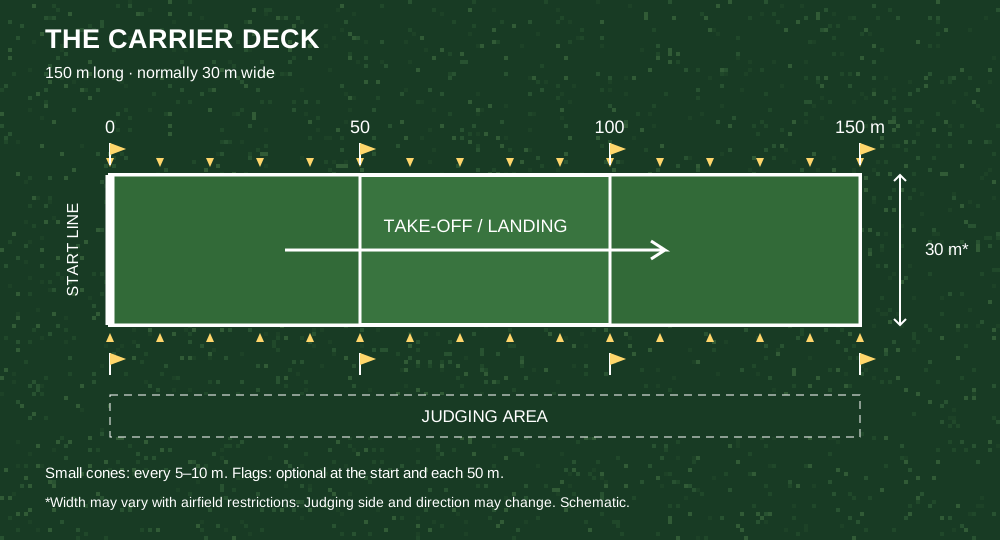
The marked scoring area is called the carrier deck. It is 150 metres long and normally 30 metres wide, although airfield restrictions can affect the width. White lines define the area, with small distance cones at intervals of 5–10 metres. Feather flags may mark the start and each 50-metre point.
Take-off
The main-wheel axles begin on the start line, with the aircraft aligned along the deck. The Airboss directs the start. The wingtips must stay within the deck’s lateral limits until the aircraft has passed its end.
Distance runs from the beginning of the start line to the point where the last main wheel leaves the ground for the final time. If a main wheel touches down again, the measurement extends to its final lift-off. An incorrect starting position or crossing the lateral limits scratches the take-off.
Landing
The main wheels must first touch down beyond the start line. A main-wheel touchdown on or before it scratches the round; the tailwheel may touch on or before it without penalty.
The aircraft stops straight ahead and stays still for measurement. Distance is measured from the start line to the main-gear axle furthest from it. The pilot waits for a judge’s clearance before leaving the deck straight ahead. Running beyond the marked landing area scratches the round.
Circuit and go-arounds
The briefing sets the circuit height and layout. Flying must remain controlled, with appropriate spacing and no steep climbs, steep turns or abrupt manoeuvres. S-turns and overly aggressive slipping on final are prohibited.
A go-around is the correct response to an unstable or unsafe approach. If no landing gear has touched the deck, the pilot can fly another circuit and make a scored landing. Go-arounds are for safety, rather than an opportunity to improve a safe approach’s score.
Aborted take-offs
If neither main wheel has left the ground, an aborted take-off can be followed by repositioning for another attempt. If a main wheel has lifted off and the circuit is not completed, the round is scratched. The decision to abort remains with the pilot.
Technique and wind limits
Pilots may stop the engine after touchdown. The wind limits are a maximum 5-knot crosswind component and 5-knot gust component. Maximum-rate climbs after take-off are prohibited.
Competing across the season
Aircraft compete within classes so that similar types can be compared. Slingshot’s target is the Fixed Wing Microlight category. An Experience Class also offers participation without points towards the annual championship.
Class placings earn season points: 25 for first, 18 for second, then 15, 12, 10, 8, 6, 4, 2 and 1 through tenth. The pilot with the most points at season’s end wins their class championship.
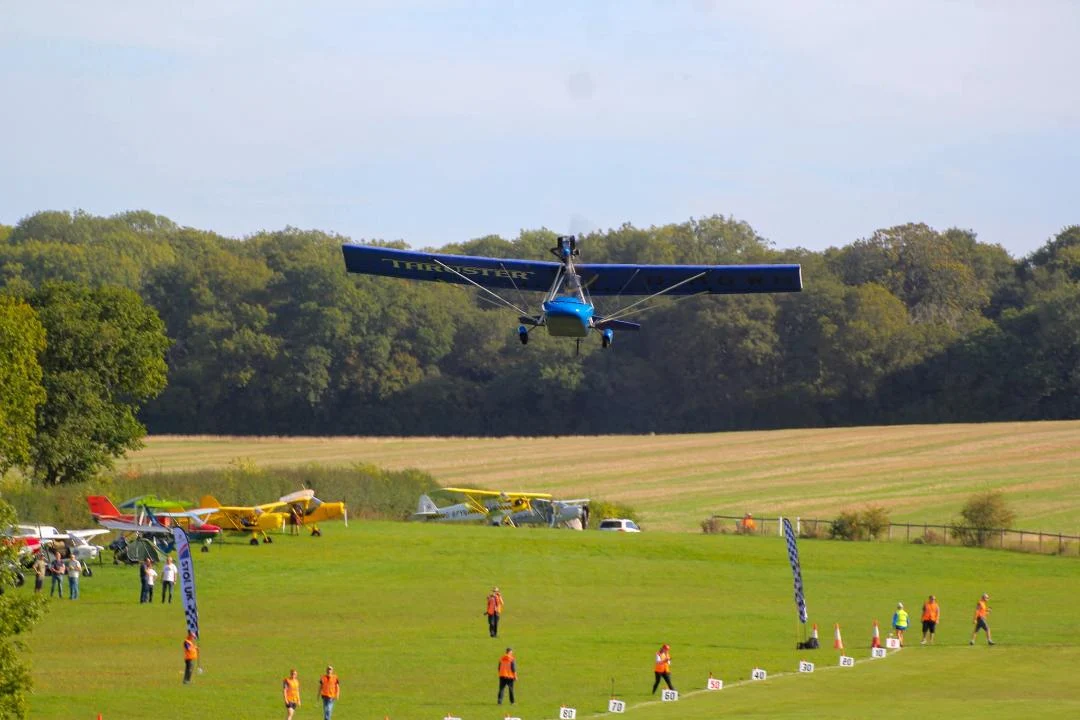
Photo: @harryahop_photography
From farm strips to competition
Simon’s interest in short-field flying began as a teenager on farm strips in Northern Ireland. Often less than 300 metres long, with approaches shaped by trees, high hedges and steep slopes, these strips were where he learned to fly.
Watching National STOL competitions in the United States on YouTube, alongside backcountry flying channels, inspired him to enter a STOL competition himself. It was a chance to take familiar skills into a new setting and explore what his stock Thruster could achieve.
Popham: the first result
At his first competition in September 2026, Simon achieved this result in his stock, two-seat Thruster T300—an aircraft never designed with or fitted with brakes. With no wind and a slightly downhill competition strip, stopping distance presented a particular challenge.
The result was an encouraging start and prompted Simon to explore how a separately developed Thruster could build on the stock aircraft’s performance.
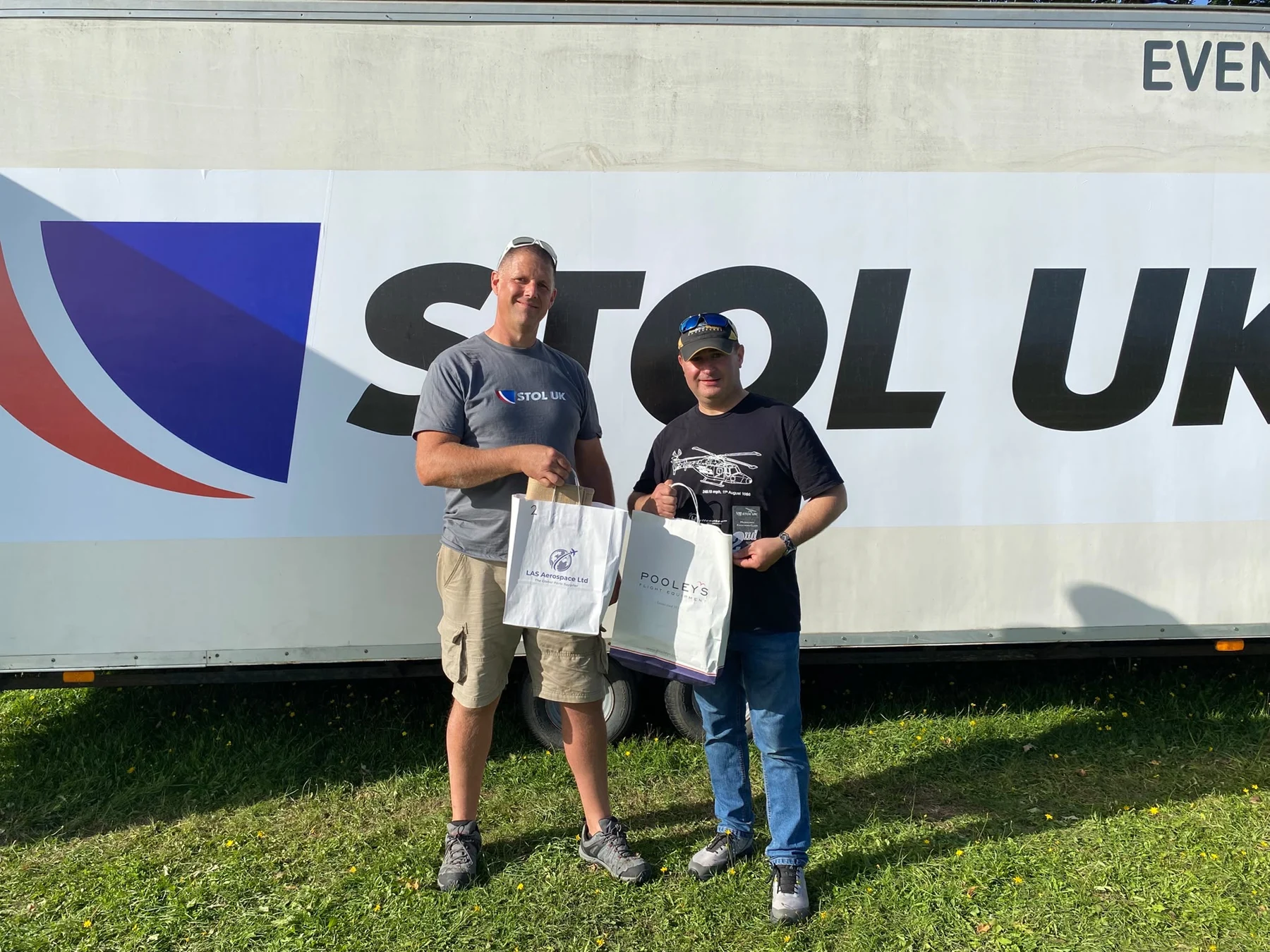
That experience provides the starting point for Slingshot: establish what the standard aircraft can do, then develop a separate aircraft and measure the difference.
The next chapter ↗